Tuesday, April 21, 2009

The Flood and The Fire - advance book information


THE FLOOD AND THE FIRE
Creation and Apocalypse in Irish Myth and Prophecy

Anthony Murphy and Richard Moore

€19.95 (Stg£17.95); ISBN 978-1-905785-66-7; paperback; October 2009;
250 pages; colour illustrations

Every generation since the birth of Christianity has believed that Armageddon was close at hand. The very notion of apocalyptic events which all but wipe out mankind is deeply ingrained into prophecy and myth, but also in memory. The idea of a great judgement of mankind has become an essential ingredient in religious belief systems, but could these beliefs have a sound basis? Why do we harbour apocalyptic thoughts? Is it because we fear judgement, or because we have a visceral memory of great events in the distant past? Perhaps it is both?
The Flood and the Fire examines the ideas of cosmogony – the beginning of the human story – and eschatology – the fear of a final judgement of mankind – from a uniquely Irish perspective. Our mythology remembers Noah’s flood, and our prophecy hints at cataclysmic events in the future. Saint Patrick prayed for unique blessings for Ireland’s people to save us from great tribulation, and is said to have left guardians on seven mountains to watch over us.
Anthony Murphy, journalist and author, takes us on a journey through Ireland’s unique apocalyptic history, and examines on a scientific, spiritual and philosophical level the extraordinary potency of man’s eschatological complex.
That journey examines many diverse subjects, including the sanctity of the landscape, the 5,000-year-old stone monuments, the symbolism of light and fire, and of water and earth, the island paradises of myth, the ever-present belief in a cosmic otherworld, the honouring of the ancestors, the meaning of megalithic carvings, the study of the stars, the fear of the gods and of retribution through the destructive forces of fire and water.
Perhaps the most significant aspect of this study is its relevance to today. We consider ourselves the masters of technology, and forgers of our own destiny, but as we face the accelerating threat posed by global warming, by the increasing challenges of feeding and maintaining the earth’s seven billion inhabitants, is there an eschatological message for us? Do we stand on the brink of potential extermination? Should we incorporate ancient cosmological wisdom into our thinking as a means to save the planet – or is it already too late for that?

About the Authors
Anthony Murphy is the editor of the Dundalk Democrat and, with Richard Moore, co-author of Island of the Setting Sun: In Search of Ireland’s Ancient Astronomers. A photographer, graphic artist and avid amateur astronomer, Anthony has almost single-handedly assembled the website www.mythicalireland.com, which receives 2,500 unique visitors daily. Richard Moore is an artist, working mainly in oils and acrylics, who has been painting the ancient sites of Ireland for over 25 years.

The Liffey Press, Ashbrook House, 10 Main Street, Raheny, Dublin 5
Tel: 01-8511458. Email: dgivens@theliffeypress.com. Web: www.theliffeypress.com

Friday, April 17, 2009

A snippet from the forthcoming book by Anthony Murphy


Solon of Athens, the Greek statesman, met a “prodigiously old man” one time, on a visit to Egypt. This ancient elder of the world told Solon of many cataclysms which had purged the earth. “There have been and there will be many and divers destructions of mankind, of which the greatest are by fire and water, and lesser ones by countless other means”.
The previous incarnation of mankind, and the current one, are separated in world mythology and beliefs by a great inundation of the earth. The narrative of this deluge is universally familiar as the story of Noah and the great ark in which he sustained and protected life from utter destruction by the elements.
All across the world, from east to west and from north to south, the recounting of this great ferocious cleansing, this prolific but unconsummated washing of humanity, echoes among young and old, great and small.
If Nimrod's tower is a symbol of our desecration of cosmic sanctity, then Noah's ark is equally a symbol of hope, that we shall not be utterly removed from our place in the harmony of cosmos, and that we should once again plant our seed abroad on the face of the earth so that the flower of humanity should flourish and blossom with the earth's blessing, not retribution.
The waters of the great flood of the earth represented a baptism of sorts, a renewing of mankind and the natural order. We once again became infants, crawling and walking on the land and learning all over again what it was like to be nourished and nurtured and to give and take in equal measure, and to share in the wonders of creation. But our re-education in cosmic union taught us of the sacredness of the world, and the bitter necessities for that union to survive included the utmost requirement for restraint. The people of the new world urgently needed to grasp and maintain the infantile humility which had been demanded of them by the rapacious, apocalypic elements.

This is a brief snippet from my next book, currently in progress, which may or may not be called "The Flood and the Fire - the beginning and the end of the world in Irish myth and prophecy".

Monday, February 9, 2009

Antediluvian occupation of Erinn


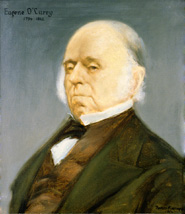
The next book of considerable antiquity that we find reference to is that called the CIN DROMA SNECHTA or Cin of Drom Snechta. The word Cin, pron in Engl Kin, is explained in our ancient Glossaries as signifying a stave of five sheets of vellum and the name of this book would signify therefore the Vellum stave Book of Drom Snechta Tne words Drom Snechta signify the snow capped hill or mountain ridge and it is believed to have been the name of a mountain situated in the present county of Monaghan. The Cin of Drom Snechta is quoted in the Book of Ballymote fol 12 a in support of the ancient legend of the antediluvian occupation of Erinn by the Lady Banbha who is, however, in other Books called Cesair, pron Kesar. There are also two references to it in the Book of Lecan. The first of these fol 271 b is in the same words preserved in the Book of Ballymote From the Cin of Drom Snechta is taken this little bit as far as Cesair See APPENDIX No IX The second is fol 77 b col 2 where the writer says in summing up the genealogies of some of the families of Connacht that he compiled them from the Chronicles of the Gaedhil.

O’Curry, Eugene, M.R.I.A., Lectures on The Manuscript Materials of Ancient Irish History, delivered at the Catholic Uniersity of Ireland, during the sessions of 1855 and 1856, P.13.

Sunday, February 8, 2009

The Elders of the End of the World

More bitter to me than Death coming between my teeth are the folk that will come after me, who will be all of one kind.

Wicked is the time which will come then; envy, murder, oppression of the weak, every harm coming swiftly, and neither layman righteous nor righteous priest.

No king who concedes right or justice, no virgin bishop over the altar, no landowner who will raise tithes from his herds and his fine cattle.

The elders who did God's will at the beginning of time were bare-haunched, scurvy, muddy; they were not stout and fat.

The men of keen learning, who served the King of the Sun, did not molest boys or women; their natures were pure.

Scanty shirts, clumsy cloaks, hearts weary and piteous, short rough shocks of hair - and very rough monastic rules.

There will come here after that the elders of the latter-day world, with plunder, with cattle, with mitres, with rings, with chessboards,

With silk and sarsenet and satin, with delightful featherbeds after drinking, with contempt for the wisdom of beloved God - they shall be in the safe-keeping of the Devil.

I tell the seed of Adam, the hypocrites will come, they will assume the shapes of God - the slippery ones, the robbers.

They shall fade away with the same speed as grass and young corn in the green earth; they shall pass away together like the flower of the fields.

The imposters of the latter-day world shall all go on one path, into the grasp of the Devil, by God' will, into dark bitter torments.

Irish, author unknown, twelfth century?
From 'A Celtic Miscellany', Penguin Classics.